Daily LifeUpdated 2026-09-27 · 10 min read
International Health Insurance in Argentina for UK Movers
For a UK move to Argentina, buy international health insurance if you need treatment in several countries, medical evacuation or continuity during trips home; choose an Argentine prepaga if most care will be local. A local plan for a 30-year-old costs roughly US$130–870 a month (September 2026), while international premiums need an individual quote.
In short
- The NHS and UK GHIC do not pay for ordinary treatment in Argentina.
- An Argentine prepaga for a 30-year-old costs about US$130–870 monthly (September 2026).
- Worldwide cover does not automatically include the UK, US or routine care abroad.
- Ask each insurer whether your chosen Argentine hospital bills it directly.
- Public emergency treatment remains free; non-residents can be charged for other public care.
International health insurance in Argentina makes sense if you will split your time between countries, want medical evacuation or need cover on visits to Britain. If you expect most appointments and admissions in Argentina, compare an Argentine prepaga (private health plan, closer to Bupa than to the NHS) first: at age 30 these cost about US$130–870 a month, or ARS 200,850–1,344,150 at ARS 1,545 per US$ (September 2026). International plans from Bupa Global, Cigna Global and Allianz Care have no single Argentina price: age, deductible, benefit limits and geographical area determine the quote.
What exactly are you buying?
International private medical insurance, often called IPMI, is an annual renewable medical policy for someone living outside their home country. It is not a short holiday policy, and it is not an entitlement to use the NHS. Check whether the quotation covers inpatient treatment only or also outpatient visits, prescriptions, maternity, mental health and dentistry. A large annual maximum means little if the particular treatment has a low sub-limit.
A local prepaga gives access to its cartilla (directory of contracted doctors and hospitals), with monthly premiums normally paid in pesos. Argentina's PMO (Programa Médico Obligatorio, mandatory medical benefits package) sets the minimum medical services that registered local prepagas must provide. An international insurer does not become a registered Argentine prepaga simply by insuring you there; do not assume the PMO's benefits or Argentine rules about pre-existing conditions apply to your overseas contract. An obra social (employment-linked health fund) is a separate route for eligible Argentine workers; ask how salary contributions interact with any prepaga before paying twice.
| Route | What you usually receive | Indicative cost and billing (September 2026) | Main limitation |
|---|---|---|---|
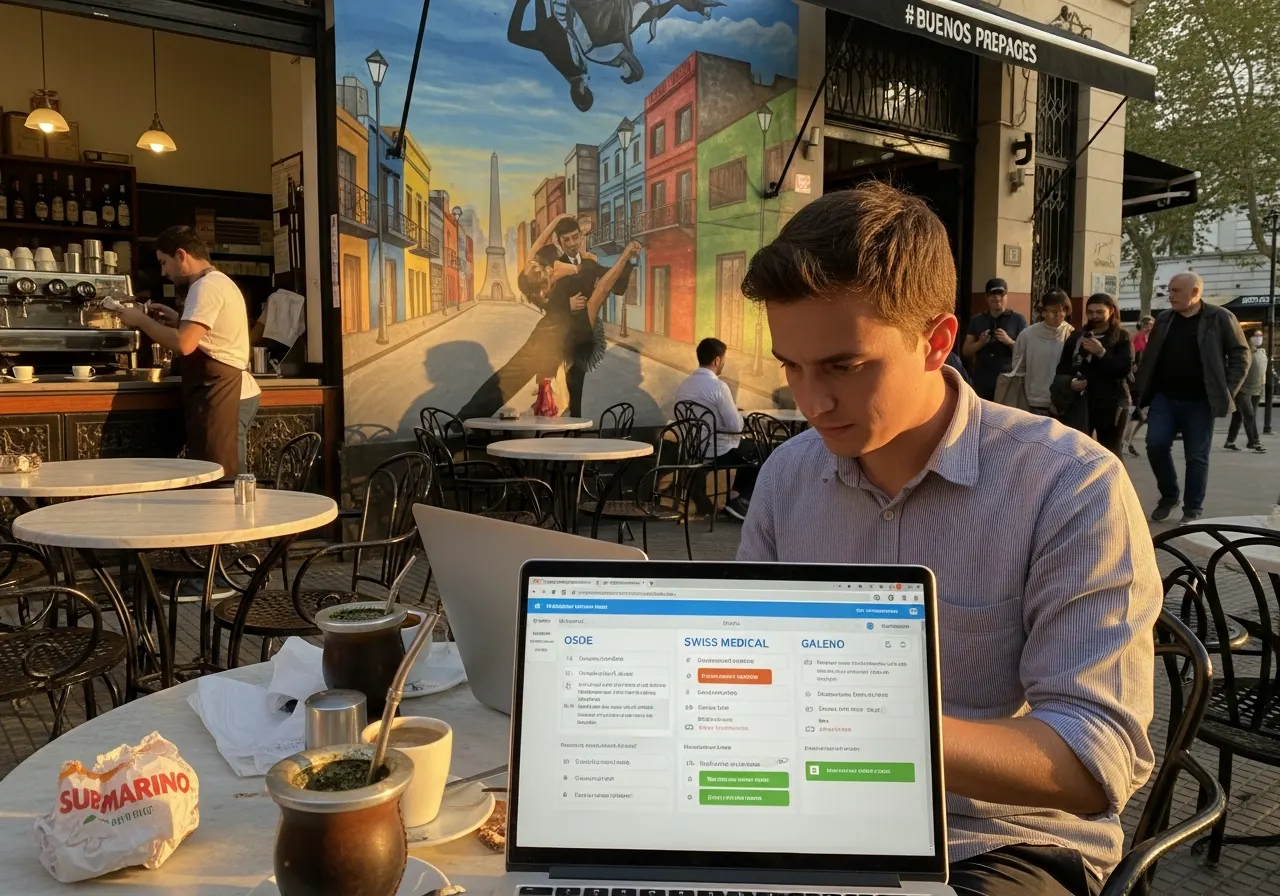
| Argentine prepaga, such as OSDE, Swiss Medical or Galeno | Network-based Argentine outpatient and inpatient care, PMO minimum | About US$130–870 monthly at age 30 by tier; roughly ARS 200,850–1,344,150 at ARS 1,545/US$, billed in pesos | Standard plans seldom provide comprehensive care abroad |
| International medical policy, such as Bupa Global, Cigna Global or Allianz Care | Medical cover in the countries, care categories and limits specified on your certificate | Individually quoted, commonly in US dollars or another contract currency; request an actual premium and renewal terms | You may need to pay an Argentine hospital first and claim reimbursement |
| Travel medical policy | Defined emergency treatment for a specified trip | Trip-specific quote, depending on dates, destination and age | Often excludes ordinary residence, planned care and ongoing conditions |
| Argentine public system | Emergency care, plus resident access to other public services | Emergency care free; non-emergency charges for non-residents depend on province and hospital | Not a substitute for contractual private cover or evacuation |
The table is not a like-for-like price comparison: the local price is an age-30 range, not a family or retiree quotation. Ask all insurers to quote the same ages and care requirements. Local premiums change often; compare a current peso quote and its payment mechanism rather than carrying an old sterling conversion into next year's budget. Currency controls for individuals were lifted in April 2025 and foreign cards now receive close to the official exchange rate, but that does not stop an insurer changing its monthly price.
Decide on territory before you compare prices
For a permanent Buenos Aires home, a local policy may cover routine appointments more simply than an international reimbursement contract. For a UK-based worker spending several months each year in Argentina, international cover might preserve access in multiple places; the actual policy territory must name Argentina. Some policies sell worldwide excluding the US at a lower premium than worldwide including the US. If you transit through or spend a month in the US, read the emergency US provision, not just the headline territorial label.
The UK is a separate question. Some expat policies restrict treatment in your country of nationality or cover emergency care there for only a defined visit length; others include it. Ask whether a six-week UK visit and a planned specialist consultation are both covered, and whether you have to notify the insurer before leaving Argentina. Ordinary residence, not British citizenship or previous National Insurance payments, determines access to free NHS hospital care; do not treat a UK passport, a UK address or the GHIC as your Argentine health plan. A UK GHIC is not valid in Argentina.
If you need continuity through a move, check the effective date, not just the purchase date. A gap between leaving your UK employer's insurance and the first day of an international or Argentine policy leaves you paying privately for those days. If your international cover is intended only as a bridge until your DNI (Argentine identity document) arrives, confirm the minimum contract term and cancellation rules before buying. For how public care and local cover fit together, see healthcare in Argentina for UK movers.
Check the hospital pathway, not just the insurer's logo
Buenos Aires hospitals are not interchangeable for billing. You could ask about Hospital Británico, Perdriel 74 in Barracas; Hospital Italiano, Juan D. Perón 4190 in Almagro; or a provider nearer your eventual home. Being an excellent hospital does not prove that it takes a particular international policy. Ask the hospital's admissions or international-patient desk whether it accepts direct settlement for your exact insurer, plan and treatment, and ask the insurer for the same confirmation in writing.
Direct settlement normally means the hospital requests a guarantee of payment or pre-authorisation. It does not promise that everything on the bill is covered: your deductible (the part you pay before insurance), co-payment, excluded medicines or charges above the plan limit can remain yours. With reimbursement, the hospital charges you first. Keep the factura (itemised invoice), proof of payment, diagnosis, prescriptions and discharge note, and ask the insurer which language and currency it accepts. A UK card with a generous limit will not remove the need to fund a large upfront hospital deposit.
Find the 24-hour assistance number, save it offline, and establish whether it can arrange admission and an ambulance in Argentina. In Buenos Aires, call SAME on 107 for an ambulance; 911 is the CABA police emergency number and 100 is for fire. For an emergency, get care first and notify the insurer within the policy's stated deadline as soon as you safely can. Check if evacuation means transfer to the nearest suitable facility rather than a flight back to Britain. Repatriation of remains, if wanted, is a separate benefit.
Six checks before you accept a quote
- Give the insurer accurate dates and status. Say when you will leave the UK, where you will principally reside, whether your Argentine residence application is pending, and every destination you regularly visit. Ask for a certificate showing Argentina as covered territory and the policy start date. A visitor on a British passport can enter Argentina for up to 90 days without a visa; the length of your stay does not itself turn travel insurance into resident cover.
- Disclose diagnoses and medication. Declare conditions, investigations and pending referrals on the health questionnaire, even if a UK doctor calls them minor. Request a written list of exclusions, loading and any waiting period. An Argentine prepaga cannot reject an applicant merely because of a pre-existing condition under Ley 26.682, although an authorised surcharge can apply; do not project this local protection onto an international contract.
- Compare a matching schedule of benefits. Put inpatient limit, outpatient visits, oncology, imaging, mental health, prescriptions, rehabilitation, maternity, newborn cover and dental beside each other. For pregnancy, ask specifically about waiting periods, birth complications and adding a baby: buying only after conception can be too late for maternity benefits.
- Check excess and payment mechanics. Get the annual deductible per person or family, co-insurance percentage, per-visit charges, premium currency and instalment schedule in writing. Ask whether direct billing works at two hospitals you might actually use and how pre-authorisation works at night.
- Test portability and exit. Ask what happens if you move from Buenos Aires to Mendoza, return to Britain, acquire Argentine employment cover or renew after a claim. Annual repricing by age, health underwriting at renewal and cancellation notice matter more than a promotional first-month price.
- Keep evidence for the move. Save the certificate, coverage area, receipt, assistance contacts and a Spanish-readable summary if offered. If Migraciones (the Argentine immigration authority) asks for evidence of health cover in your particular immigration procedure, provide the actual certificate and terms; do not assume that any overseas policy automatically satisfies the category's requirements. See visa routes for UK citizens for the underlying residence choice.
Worked budget: two UK movers in Buenos Aires
Take two 30-year-olds moving to Buenos Aires for a year, both needing ordinary Argentine care and one making two short visits to Britain. Suppose each is offered a local mid-range plan at US$250 equivalent monthly in September 2026. That is US$500 a month for both, about ARS 772,500 at the stated official rate, or US$6,000 over 12 months if the peso price and exchange rate were unchanged. They will not be unchanged in practice: use the arithmetic as a comparison template, not a renewal forecast. At a household income of US$4,000 monthly, that initial US$500 is 12.5% of income.
They request an international quote for two people, Argentina and UK territory, outpatient and inpatient treatment, a stated deductible and evacuation, plus a separate quote excluding outpatient care. They write the *actual* premiums and deductible into the same 12-month spreadsheet rather than treating the local US$250 assumption as an international market price. If the international insurer requires reimbursement at their chosen Buenos Aires hospital, they also reserve cash for the largest amount they could have to front. If its UK section allows only emergencies on trips home, it does not meet a need for planned UK follow-up; they would need a different policy or a separate arrangement.
A 62-year-old couple with a UK State Pension and a SIPP should not apply the age-30 range to themselves. Get both ages individually quoted, examine cancer cover and repeat medicines, and compare the premium against an Argentine prepaga plus separate travel or evacuation benefits. For the residence income test and retirement route, see the pensionado visa guide; health insurance does not replace proof of pension income.
Avoid these expensive mistakes
A low premium can conceal an inpatient-only policy; buy it knowingly rather than expecting GP visits and prescription refills to be included. A worldwide label can conceal US and home-country limits. A broad hospital list can conceal reimbursement-only billing: confirm direct settlement with both parties before the first appointment. Do not cancel UK or employer cover before the new contract starts, or misstate a previous diagnosis to save premium. And do not assume public hospitals will provide a free elective fallback: under DNU 366/2025 non-residents can be charged for non-emergency care, while emergency treatment remains free and residents with a DNI retain free public access; provinces set their own rules.
If you are settling permanently and rarely travel, this page's cross-border cover may not be necessary: use the OSDE, Swiss Medical and Galeno comparison to shortlist local plans. If the immediate worry is carrying regular UK medication rather than insurance territory, read the prescription medicine guide before packing. Neither an insurer's claims desk nor your UK GP can guarantee that a particular brand will be available locally.
Questions
- Do I need international health insurance to live in Argentina?
- Not automatically. A local prepaga may be more practical if you mostly use Argentine clinics; international cover is worth quoting when you need treatment across borders or evacuation. Any immigration evidence of insurance depends on your specific residence procedure, so retain the actual policy certificate.
- How much does international health insurance cost in Argentina?
- There is no standard Argentina premium: insurers price by age, territory, benefits and deductible. As a separate benchmark, a local prepaga for a 30-year-old costs around US$130–870 monthly, about ARS 200,850–1,344,150 at the September 2026 official rate. Obtain comparable individual international quotes rather than assuming that local price buys worldwide cover.
- Will my international insurer pay Hospital Británico directly?
- That depends on the exact policy and on the hospital's current billing agreement. Ask the insurer and Hospital Británico's admissions team about direct settlement and pre-authorisation for your treatment. Otherwise budget to pay first and submit itemised invoices for reimbursement.
- Does worldwide health insurance cover visits back to the UK?
- Only if the contract includes the UK and its home-country rules allow your visit length and type of treatment. Emergency treatment during a visit and planned treatment are different benefits. Your British passport does not by itself preserve free NHS care after you cease to be ordinarily resident in the UK.
- Can I buy an international policy instead of an Argentine prepaga with a pre-existing condition?
- You can apply, but an international insurer can underwrite or exclude an existing condition under its policy terms. Argentine registered prepagas operate under Ley 26.682 and cannot refuse you solely for a pre-existing condition, although an authorised extra charge can apply. Disclose the condition and compare the written terms before replacing existing cover.