Healthcare in Argentina for British Expats
How healthcare actually works in Argentina for British expats — the public/private/prepaga split, choosing a plan, the British Hospital, NHS-vs-OSDE comparisons, and what to do for emergencies, prescriptions, and pre-existing conditions.
 Thomas SinclairWriter and editor · London
The British Hospital of Buenos Aires has been operating since 1844 and remains the natural medical home for the British community in Argentina — bilingual staff, English-language patient information, and the only hospital in the country whose maternity ward sends out a Christmas card from the Ladies' Committee.
Argentina has a hybrid healthcare system that combines a free public network, employer-linked obras sociales, and private prepagas. The system is genuinely complicated when described in full but simple in practice for British arrivals: nearly all opt for a prepaga from the moment they arrive, treat the public system as a backstop, and use the British Hospital in Buenos Aires (Hospital Británico) as their hospital of choice.
This guide assumes a UK national arriving with private means or an employer offering a prepaga as part of relocation. For visa-related healthcare considerations and the residency-permit process, see Argentina Visa for UK Citizens.
How the Three Tiers Work
1. The public system (sector público). Free at point of use, available to anyone in the country (residents, tourists, and undocumented migrants alike). Operated by federal, provincial, and municipal authorities. Quality varies enormously by hospital. The Hospital Italiano público side, the Hospital Argerich, and the Hospital de Clínicas in Buenos Aires are excellent and would be acceptable choices in any European country. Public hospitals in poorer provinces are visibly under-resourced. Waiting times for elective procedures are similar to or worse than NHS waiting lists.
2. Obras sociales. Employer-linked sickness funds, mandatory for any registered employee in Argentina. Each professional sector has its own (e.g., construction workers, teachers, lawyers). Employee contribution is a percentage of salary; employer contributes too. Coverage is broadly mid-tier private. British expats employed by Argentine companies will be in one automatically; those self-employed or paid abroad typically are not.
3. Prepagas. Private health insurance providers. Five main national providers: OSDE, Swiss Medical, Galeno, Medifé, and Omint. Plans range from basic (essentially equivalent to obra social tier) to premium (Mayo Clinic-style international cover). Most British expats opt for one of these on arrival.
The Five Main Prepagas
Brief summary of the five:
OSDE (Organización de Servicios Directos Empresarios). The largest, the most well-regarded, and the default for most British arrivals. Runs OSDE-branded clinics across the country. Plan numbers run 210, 310, 410, 510 — higher numbers cover more. OSDE 410 is the typical British-expat tier; OSDE 510 is for those wanting top-tier coverage. Maternity carencia is 9 months. Acceptance of pre-existing conditions varies; expect declarations and possible exclusions.
Swiss Medical Group. The second-largest. Owns the Sanatorio Mater Dei (Palermo) and several other Buenos Aires hospitals. Plans labelled SB1, SB2, SB3, etc. Often slightly cheaper than OSDE for equivalent cover. Strong in zona norte.
Galeno. Owns the Sanatorio Otamendi in Recoleta. Plans labelled Plata, Oro, Platino. Strong in Recoleta and Palermo.
Medifé. Mid-tier, smaller network, often best value at the entry-mid level. Less premium-tier reach than OSDE or Swiss Medical.
Omint. Smaller, longest-standing, with a particularly strong reputation for chronic-condition management. Higher acceptance threshold for pre-existing conditions than the larger providers.
Choosing a Plan
The decision tree is roughly:
- Are you under 45 and healthy? Mid-tier plan (OSDE 410, Swiss Medical SB1, Galeno Oro). USD 280-450/month for a couple.
- Do you have a child or are planning one? Mid-tier or above, and join at least 9 months before conception (the maternity carencia). USD 450-700/month for a family of four.
- Do you have a pre-existing chronic condition (diabetes, MS, IBD, cardiac)? Top-tier plan with a provider that has accepted your condition in writing before you sign. USD 600-1,000/month. Get the acceptance in writing from the medical underwriting team — verbal commitments do not bind the company.
- Are you over 60? Top-tier or premium plan; expect higher monthly premiums (USD 600-900/month single, more for a couple). Some providers cap acceptance for new members above certain ages — check before assuming you can join.
The official medical declaration (DDJJ médica) is taken seriously. Failure to disclose a pre-existing condition can void your cover later. Disclose everything and let the underwriter price the policy correctly.
The British Hospital (Hospital Británico)
The natural medical home for the British community in Argentina. Located at Perdriel 74, Barracas (about 15-25 minutes south of Palermo by car). Founded 1844 by the British community. Operates as a fully private hospital today and accepts all the major prepagas.
What makes it distinctive for British expats:
- Bilingual senior staff — most consultants and a high proportion of nurses speak working English
- English-language patient information, signage, and discharge letters available on request
- Modern facilities — refurbished in stages over the past 15 years, the maternity wing rebuilt in 2017
- Bilingual GP service that functions like a UK GP practice — same-day appointments, repeat prescriptions, vaccination clinics
- Strong international links — many consultants have trained in the UK, US, or Europe
- Active British community ties — the Ladies' Committee runs fundraising and welcome events for British patients
Most British expats register at the British Hospital as their primary clinic on arrival. The registration process is straightforward — bring your DNI/precaria and your prepaga card, fill in the medical history form, and you are entered into the system.
For pregnancy and maternity care specifically, see Healthcare for Adults in Buenos Aires (sister site Brits in Argentina) and Pregnancy and Maternity Care in Buenos Aires.
Other High-Quality Hospitals
The British Hospital is not the only excellent option. Other hospitals where British expats commonly receive care:
- Hospital Italiano (Almagro). Founded by the Italian community, comparable in standard to the Británico, with one of the strongest neonatology and oncology departments in the country.
- Sanatorio Mater Dei (Palermo, Swiss Medical). Boutique, popular with the professional class, modern facilities.
- Sanatorio Otamendi (Recoleta, Galeno). Strong reputation, particularly for cardiology and orthopaedics.
- Sanatorio de Los Arcos (Palermo). Newer, hotel-like, increasingly chosen by younger expats.
Your prepaga determines which of these you can attend without paying extra; OSDE accepts most, Swiss Medical primarily its own network (Mater Dei + a few others).
What Coverage Looks Like in Practice
For a typical OSDE 410 family-of-four policy:
- GP appointments: same-day or next-day at the clinic of your choice; no co-payment.
- Specialist appointments: typically within a week, sometimes same day; small co-payment in the order of ARS 5,000-15,000 (£3-10).
- Routine blood work, ultrasounds, and X-rays: covered, no co-payment when done in the OSDE network.
- Major imaging (MRI, CT, advanced cardiology): covered, may require pre-authorisation and a small co-payment.
- Hospital admission, surgery, and inpatient care: covered fully at the hospitals in your plan's network.
- Maternity: covered fully after the 9-month carencia, including all antenatal care, ultrasounds, the birth, and the standard 3-4 night hospital stay (4-5 for C-section).
- Prescriptions: covered at 40-70% depending on the medication and plan tier; the rest you pay at the pharmacy.
- Mental health (psychotherapy): covered, typically 50% co-payment at the practitioner of your choice.
What Coverage Does NOT Include
- Dental care beyond emergency basics — separate dental insurance recommended (USD 30-80/month) or pay-as-you-go (Argentine dentistry is competent and cheap).
- Optical beyond basic eye tests — pay-as-you-go for glasses and contacts.
- Cosmetic procedures unless medically justified.
- Experimental treatments and many newer cancer drugs (each prepaga has its own approved-medication list).
- Treatment outside Argentina — most plans do not cover overseas treatment unless the premium "international" tier is specifically purchased.
What About the NHS?
The UK and Argentina once had a reciprocal health agreement. It ended in 2010. The GHIC and EHIC do not work in Argentina. UK travel insurance covers tourist visits but not ongoing residency.
If you remain ordinarily resident in the UK and visit Argentina temporarily, you can use NHS services on returning to the UK. Once you become Argentine-resident (typically after the first 6-12 months and confirmed by the Statutory Residence Test), you lose NHS entitlement except for emergency treatment if you visit the UK as a returning national.
For UK-side considerations on tax residency and the NHS question, see UK Tax for Argentina Expats (HMRC).
Emergencies
The 24-hour emergency number for ambulances is 107 (the Argentine equivalent of 999 for medical emergencies). The major prepagas also operate their own emergency call lines that send a private ambulance — typically faster in central Buenos Aires than the public 107 service. The relevant numbers are on the back of your prepaga card.
For severe emergencies, the closest hospital A&E will accept you regardless of insurance — there is no UK-style "are you registered with us" gatekeeping for genuine emergencies.
Prescriptions and Pharmacies
Pharmacies (farmacias) are widely distributed and most are open until 22:00, with a rotating 24-hour duty pharmacy in each barrio. Common medications are available and cheap. Branded medications cost more than UK NHS prescription rates but generic equivalents (genéricos) are usually 30-60% cheaper than the UK equivalent.
Prescription medicines that are routinely available in the UK without prescription (e.g., higher-dose ibuprofen, codeine combinations) often require an Argentine prescription here. Bring a 3-month supply of any chronic medication on arrival, plus a written GP letter detailing the medications and dosages.
Vaccinations
Routine UK childhood vaccinations are recognised and recorded by Argentine paediatricians on arrival. The Argentine national programme covers a similar set plus a few extras (BCG, hepatitis A as routine, dengue in endemic areas). Yellow fever vaccine is required if travelling to or from certain northern provinces and to neighbouring countries.
For visa-related medical-clearance questions, see Argentina Visa for UK Citizens.
Pre-Existing Conditions
Argentine prepagas can decline to cover pre-existing conditions and can apply waiting periods or exclusions. The new "Ley de Coberturas Médicas" reforms have tightened consumer protections somewhat, but underwriting still applies.
If you have a significant pre-existing condition (cancer history, MS, organ transplant, complex cardiac history), the path is:
- Get a written medical underwriting decision from each prepaga before signing — submit your full UK medical records translated to Spanish.
- Compare the offers in writing. Some providers will exclude treatment for that specific condition; others will cover it after a waiting period; a few will cover it from day one.
- Pay attention to the small print on chronic-disease medication coverage. Some plans cover the consultations and procedures but not the long-term medication, which can run to thousands of dollars per month for biologics and oncology drugs.
For complex cases, an Argentine specialist health insurance broker is worth their fee. Recommendations come via the British Hospital ladies' committee or the Embassy's recommended-provider list.
For the wider context on settling in to Argentina, see Argentina Visa for UK Citizens, Cost of Living in Argentina for UK Citizens, and British Community Institutions in Argentina.
Frequently Asked Questions
Does the NHS cover UK citizens in Argentina?
No — the UK-Argentina reciprocal health agreement ended in 2010, and the GHIC/EHIC do not apply in Argentina. UK travel insurance covers tourist visits but not ongoing residency. British expats living in Argentina need either private health insurance (a prepaga) or to use the free Argentine public hospital system.
How much does private health insurance in Argentina cost for a British family?
Mid-tier coverage for a family of four (parents in their 30s-40s, two children, plans like OSDE 410 or Swiss Medical SB1) runs USD 450-700/month — broadly comparable to UK private medical insurance for an equivalent family. Top-tier coverage (OSDE 510, premium plans) runs USD 600-1,000/month. Older couples and those with pre-existing conditions pay more.
Is the British Hospital in Buenos Aires only for British people?
No — Hospital Británico is a fully private hospital open to all patients, accepting all the major Argentine prepagas. It retains strong British community ties (founded 1844 by the British community, active Ladies' Committee, bilingual staff, English-language patient information available) but operates as a mainstream Argentine private hospital with patients of all nationalities.
Sources & Official Links
When the answer depends on your case
The guides on this site cover the general shape of Argentine immigration. For case-specific advice, including complex visa categories, residency or citizenship questions, cross-border tax obligations, time-sensitive filings, or family situations, a qualified lawyer can review your actual paperwork.
Lucero Legal can review your paperwork and explain the options for your case. Ask about the adviser responsible, scope, and fees before you proceed.
Talk to Lucero LegalAlso from Lucero Legal
Related Guides
 Daily Life
Dental Care in Argentina for UK Expats: Costs, Quality and NHS Alternatives
Argentine dentistry is high-quality and remarkably cheap. Some British expats save enough on dental work alone to justify the flight.
Read guide →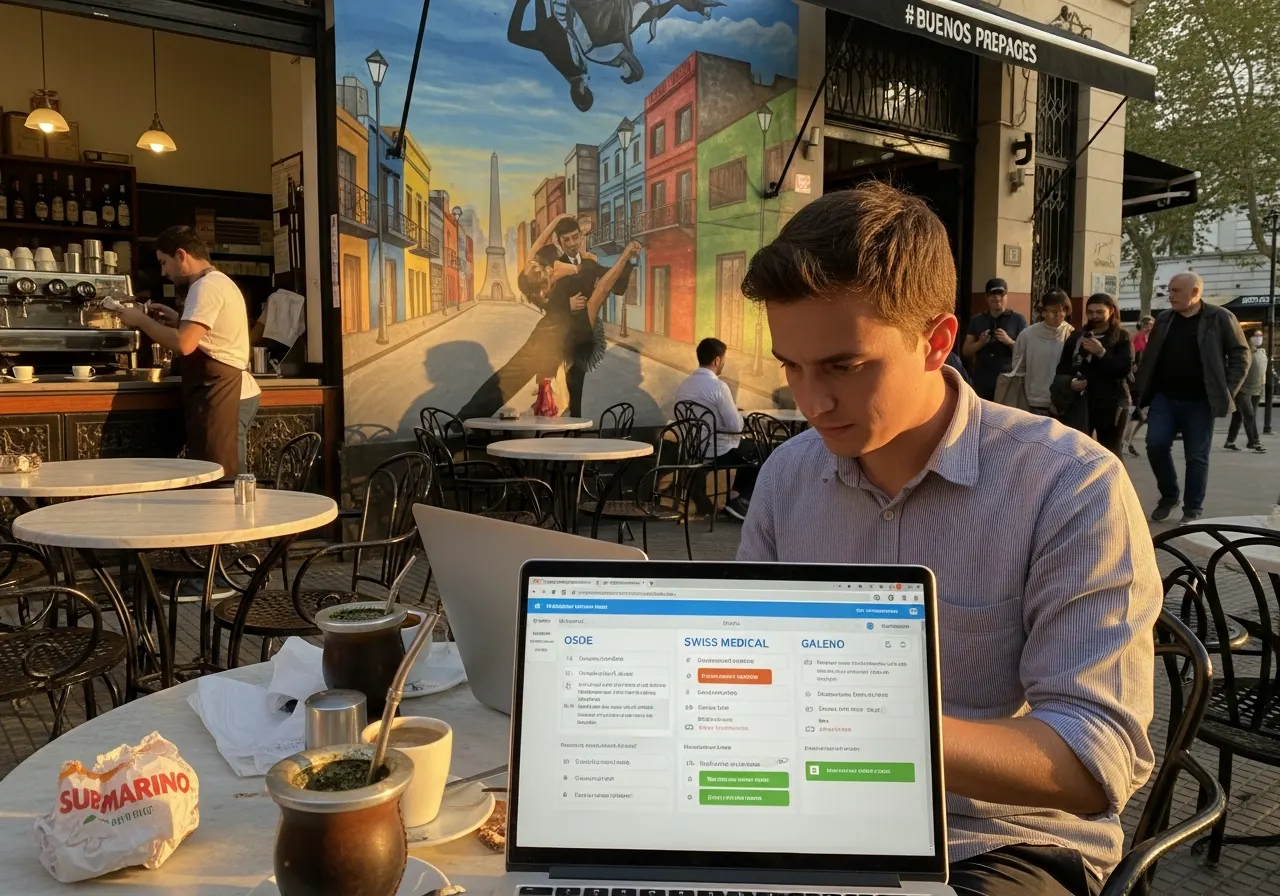 Daily Life
Argentina Private Health Insurance: OSDE vs Swiss Medical vs Galeno
Private health is the UK expat's first major recurring expense in Argentina. The three big prepagas look similar but differ sharply in hospital access and tier pricing.
Read guide →Daily LifeArgentine Bureaucracy Survival Guide for British Expats
Argentine bureaucracy is not broken. It just works differently from gov.uk. Understanding the system saves days of frustration.
Read guide →